
If you run or market a conference, events or training company, most people who look at your next event will not register that day. They check the agenda, speakers, city and dates. Then someone else approves the spend.
So what does your new website give them to do in the meantime?
This guide answers that using a site we launched in July 2026 for a company running executive conferences, summits and training across Africa. I will call them Summit House. That is not their name. You can see the live site here.
You can do all of this yourself. I will say what we did and what to look out for.
Why events websites lose buyers who are not ready yet
A typical events site has one action: register. That works for the delegate whose budget is signed off. It does nothing for the director who still needs approval.
That director is a lead. If the only button asks for full commitment, they leave, and you never learn they were there.
A soft lead has shown interest but not intent. They want to hear more, not to buy yet.
A soft opt-in is the small step that captures a soft lead. On an event page it asks for an email and phone number and says "keep me informed about this event".
A hard opt-in is the firm commitment: a full registration with name, company and role, ready for the attendee list.
One caution: in UK privacy law, "soft opt-in" has a narrower legal meaning about emailing existing customers. I mean the sales sense here. Check your consent wording.
Four ways to raise a hand, from soft to hard
Summit House's site has four forms, one for each level of readiness. That is user-centric design applied to a sales process.
- Newsletter. Email only, in the footer and blog.
- Event interest. Email and phone on every event page: the soft opt-in. When an event sells out, it becomes a waitlist.
- Enquiry. The contact form, for questions, groups and sponsorship.
- Registration. The hard opt-in. Name, company (required) and role.
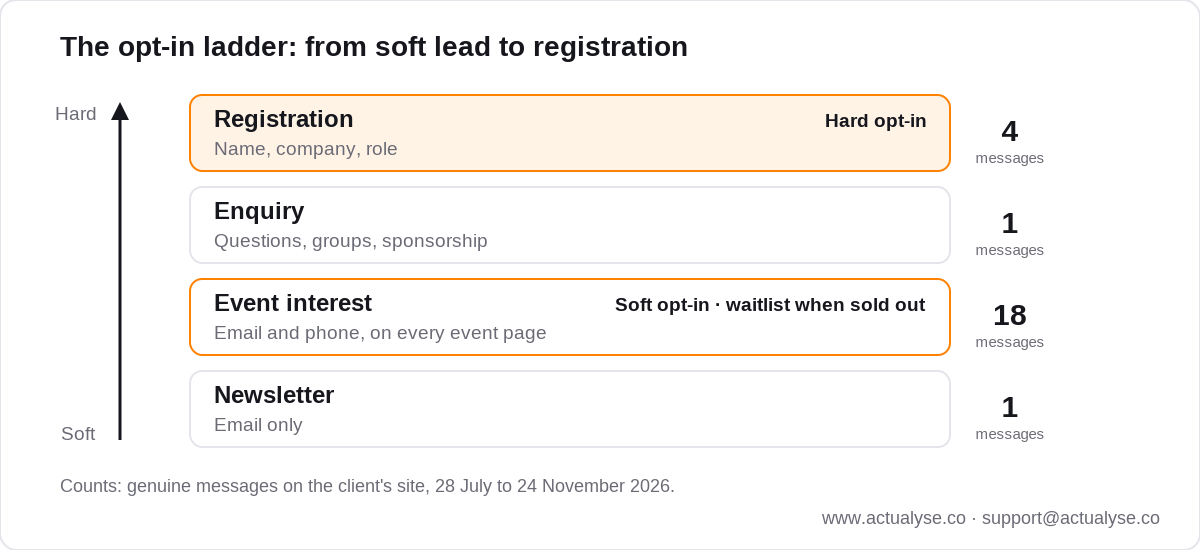
The soft opt-in matters most. A director who cannot commit budget today can still leave their details against a specific conference, and your team follows up by phone or email. That suits buyers who need approval and a relationship before they sign.
When you brief your own site, ask for this ladder by name: what each form collects, where it appears, who gets notified.
Own registration before you buy a booking tool
The original plan was to run registration through a third-party booking platform whose fees were out of proportion for the business. The site's most important action would have depended on a tool nobody had bought.
We took that dependency out. Registration runs through the site's own forms, and the pages were built so a booking platform can be layered on later without redoing them.
Weighing a booking tool? Ask whether visitors must leave your site to raise a hand, and whether you see every attempt. Leave the site and you lose some people. No visibility and you lose sight of all of them.
Save every lead first, email it second
Every form saves the submission inside the editor, then sends an email. Some notifications were misconfigured at launch. No lead was lost.
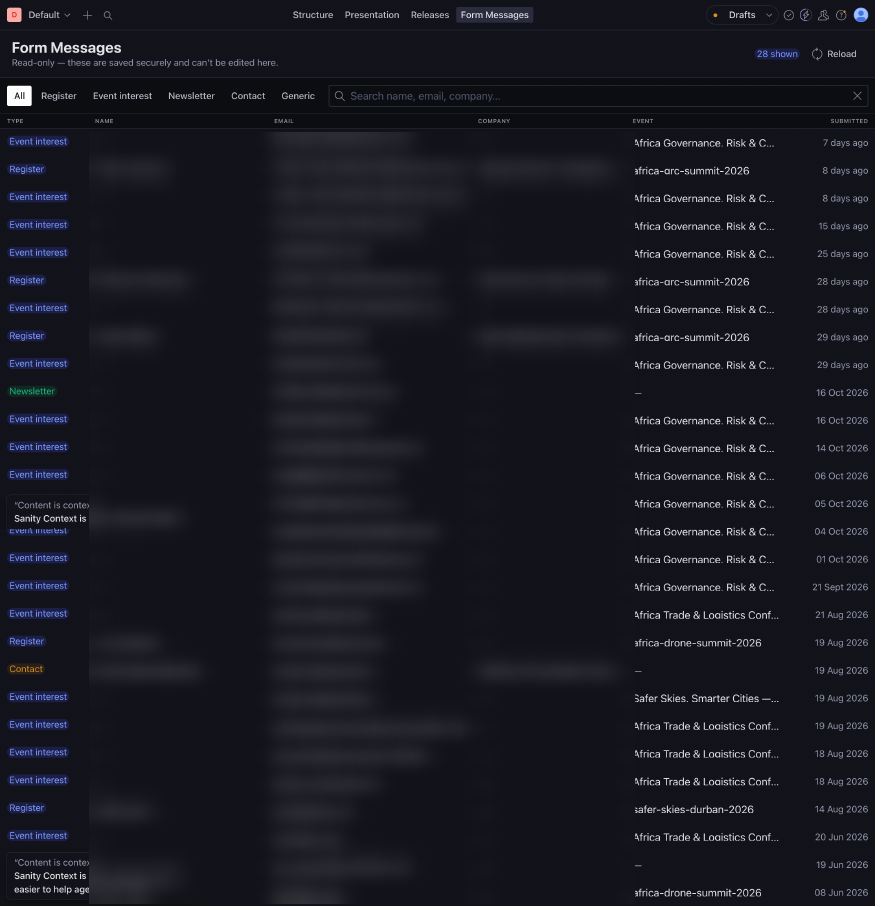
Ask for this in any new build. A lead that only exists in an inbox can disappear with one wrong setting.
What came in for this conference company
The site went live on 28 July 2026. I pulled the submissions screen on 24 November, excluding our tests.
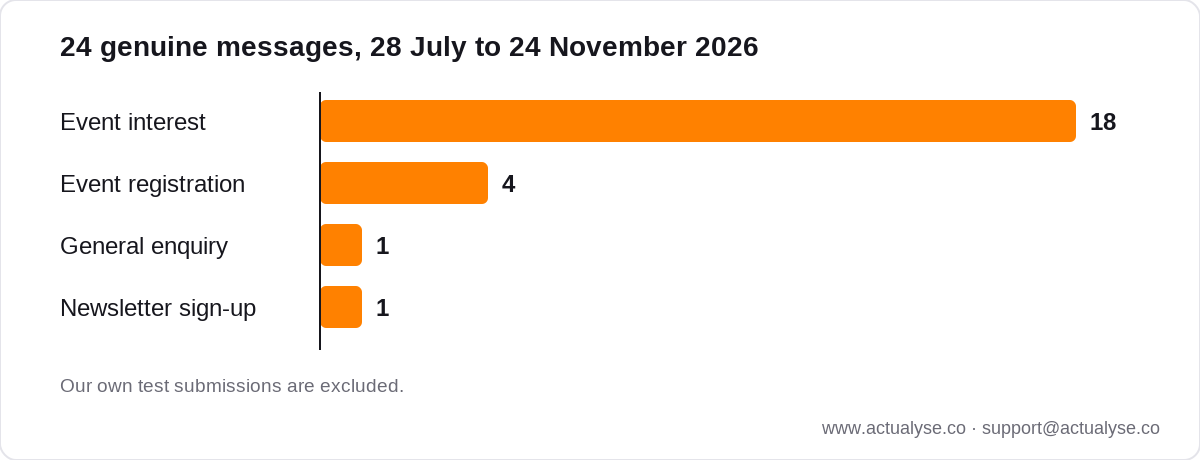
The first real message arrived on 18 August. Most were event interest: the soft opt-in doing its job.
Senders include people at central banks, a national ministry, a revenue authority, a reinsurer and a power utility, in at least five countries.
Not all of this came from search. And 24 messages is not 24 delegates, because several people registered interest and later registered. That is the ladder working: a soft lead becoming a hard opt-in.
The SEO every events company should get with the build
We did hygiene only:
- One canonical address, with other versions redirecting to it.
- A sitemap, and nothing blocking search engines.
- Clean event URLs, with automatic redirects on rename.
- Title, description and social image fields.
- A prompt to describe each image.
- Fast pages.
No keyword research, link building or articles from us. Any competent build should include this. If yours does not, run a B2B SEO audit.
Download the events website SEO checklist (PDF)
What to do after launch
- Connect Search Console and submit the sitemap.
- Tag where each enquiry came from, so you know which channel fills each rung.
- Keep past events live, pointing to the next edition.
- Publish two to four articles a month, each tied to an upcoming event. See a B2B SEO strategy built around how buyers research.
- Choose topics from real questions from speakers, delegates and sponsors. See B2B SEO keyword research.
- Add event markup, so dates and venue can show in results.
- Collect real delegate quotes. See how case studies shorten B2B sales cycles.
That is steady work on a site that can take it, which is how we approach SEO for B2B firms.
FAQ
What is a soft opt-in on an events website?
A short event-page form, usually email and phone, for people who want updates but are not ready to register.
What is the difference between a soft lead and a registration?
A soft lead has shown interest. A registration is a hard opt-in, ready for your attendee list. Your team moves one to the other.
Does SEO work for conference and events companies?
Yes. Each event has a clear topic, place and audience to write about, and a page to send readers to.
Summary
- Give buyers a step smaller than registering: a soft opt-in on each event page.
- Build a ladder: newsletter, event interest, enquiry, registration.
- Own your registration path before buying a booking tool.
- Save every submission before emailing it.
- Here, 24 genuine messages came in by 24 November, 18 of them event interest.
- Ship SEO hygiene with the build, then add Search Console, source tagging and event-led articles.
Actualyse builds B2B SEO programmes that compound into a durable source of qualified pipeline. Book a call to talk through where yours stands.