
Why B2B website personalisation fails after launch
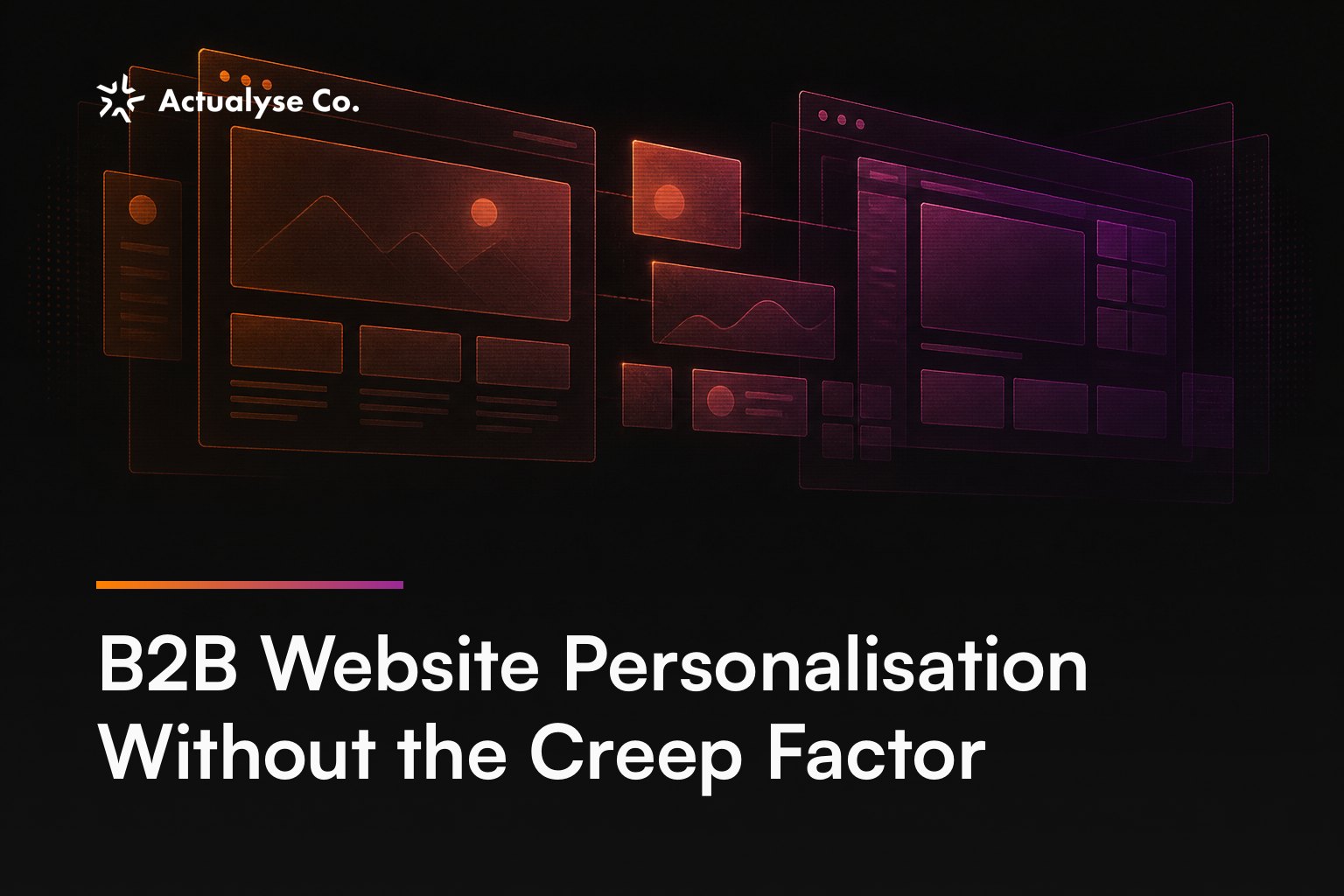
B2B website personalisation should usually stop at two or three audience variants. A fourth may deserve a place when it carries enough pipeline, but every addition multiplies the copy, proof and QA that somebody must keep current. Nearly all B2B website personalization projects fail on maintenance rather than technology, so the only version worth building is segment-level and small enough for one person to keep true.
The creep factor is not caused by relevance. It appears when a page reveals knowledge the visitor did not knowingly supply, or presents a guess as fact. The quieter failure comes later: a tailored case study expires, an offer changes, and the “relevant” route becomes specifically wrong.
Every changed block is a live content unit. As an illustrative scope comparison:
2 segments × 1 page × 2 changed blocks = 4 units
5 segments × 4 pages × 3 changed blocks = 60 units
That is 4 items to verify versus 60 before counting the truthful default, tracking or fallbacks.
Four projects show the more durable pattern. Lanteria HR’s broad Microsoft 365 platform was organised into explicit stakeholder, industry and capability paths. Savgen’s technical offer was routed by capability and sector. AfriCap Hub used event categories and filters to let delegates narrow a catalogue. Lake Erie Shores, an architectural analogy outside B2B, separated “stay” from “ownership” while sharing the material both audiences needed. None of those architecture decisions depends on announcing that the website has identified a person.
That audience-led architecture also shapes our website design and redesign work. The honest limit here is that these case studies document design decisions, not conversion figures; they show feasible patterns, not quantified uplift.
Maintainable relevance beats automated recognition.
A four-rung feasibility ladder for B2B website personalisation
Start with the hours a named owner can protect every month, then choose the scope. These are planning allowances, not industry benchmarks, and they exclude initial build time.
| Rung | Feasible segment-level scope | Monthly maintenance burden |
|---|---|---|
| 1. Visible self-selection | Two static audience routes sharing one factual core | 2–3 hours per month |
| 2. Campaign-aligned pages | Two stable segment pages with matched promise, proof and next step | 4–6 hours per month |
| 3. Rule-based modules | Up to three variants, two changed blocks and two pages, using declared choice or page context | 8–12 hours per month |
| 4. Known-contact lifecycle | Up to three CRM-defined segment variants, with a default for everyone else | 16–24 hours per month |
Rung 1 at 2–3 hours is a different operating commitment from Rung 4 at 16–24 hours. None of the four rungs requires an enterprise personalisation platform on a sub-scale site.
Use four capacity rules:
- Fewer than 4 owner-hours per month → stop at Rung 1.
- 4–7 hours → use Rung 2 and keep the pages static.
- 8–15 hours → permit Rung 3, capped at 12 live content units.
- 16 hours or more → consider Rung 4 only when CRM stages and offers have named owners.
If the CMS cannot share common facts and preserve a reliable default, fix the content model before adding rules. New routes that alter core URLs belong in a redesign process that protects organic visibility and a separate launch-day website migration checklist, not inside a personalisation experiment.
Our falsifiable claim is that Rung 3 will not stay accurate below 8 owner-hours a month; prove it wrong by logging three consecutive months below 8 hours with every route, claim and CTA reviewed and no stale item.
Choose the highest rung one named owner can sustain.
When a segment earns its own variant
Volume alone is not enough; commercial difference, usable demand and ownership must clear three gates.
- Difference gate. At least two of these three elements must materially change: the problem or promise, the proof, and the next step. One changed noun means no variant.
- Demand gate. Require either 150 qualified sessions per month or £40,000 of segment-influenced pipeline per quarter. Below both thresholds, use a visible navigation route or shared page section.
- Ownership gate. Name one editor, reserve the ladder’s monthly hours and book the first review within 30 days. A blank owner or review date blocks launch.
A qualified session is a non-bot, non-internal visit matching the declared segment signal. “Influenced pipeline” needs one consistent CRM definition; changing that definition mid-test invalidates the comparison.
Take an illustrative UK cyber-security consultancy considering a manufacturing variant. All £ inputs exclude VAT. The nine labelled inputs are:
| Input | Illustrative value |
|---|---|
| Eligible manufacturing sessions | 240 per month |
| Baseline qualified-opportunity rate | 2.0% |
| Average qualified-opportunity pipeline value | £20,000 |
| Win rate | 25% |
| Gross margin | 60% |
| Initial build cost | £4,000 |
| Evaluation period | 6 months |
| Maintenance time | 6 hours per month |
| Fully loaded owner cost | £60 per hour |
The re-runnable arithmetic is:
Monthlyised cost = (£4,000 ÷ 6) + (6 × £60) = £666.67 + £360 = £1,026.67
Expected gross profit per qualified opportunity = £20,000 × 25% × 60% = £3,000
Break-even extra opportunities = £1,026.67 ÷ £3,000 = 0.3422 per month
Break-even rate gain = (0.3422 ÷ 240) × 100 = 0.1426 percentage points
Break-even variant rate = 2.0000% + 0.1426 percentage points = 2.1426%
The decision is whether a 2.0000% baseline versus a 2.1426% break-even rate is credible enough to test. Use 30 days for routing and copy QA versus at least 90 days, or one complete sales cycle if longer, for a pipeline decision.
What this calculation cannot tell you is whether the variant caused a change. Channel mix, seasonality and sales follow-up confound the comparison; the maths sets the commercial hurdle rather than predicting uplift.
A segment earns a variant through evidence, not enthusiasm.
If this analysis exposes wider gaps in your site, we can turn the evidence into a focused redesign brief — book a call
Build segment-level personalisation without the creep factor
The visitor should be able to explain why the page changed. Four build rules keep the explanation obvious.
- Use declared context first. A selected sector, use case, event category or campaign promise is legible. An inferred employer, job title or budget is not. Ambiguous signals go to the default.
- Change substance, not tokens. “Acme Ltd needs faster reporting” replacing “Your company needs faster reporting”, or “Leeds manufacturers” replacing “UK manufacturers”, leaves the paragraph identical. The swap is detectable in a basic text diff and by a reader opening two routes; it reads as automation, not attention. If fewer than three differences change the problem, proof or next step beyond company and city tokens, reject the variant.
- Keep a shared truth layer. Capabilities, security statements, prices and delivery terms need one maintained source. Change framing, proof order and the appropriate CTA only when the segment genuinely changes them.
- Make correction easy. Show a clear audience selector, retain a truthful default and provide an obvious route back to it.
Tone also carries the recognition signal. A named company dropped into generic prose feels synthetic; a defined B2B brand personality makes genuinely tailored copy sound like the same firm across every route.
Wrong and specific is worse than broad and true.
What personalisation does not fix
Three failures sit upstream of any variant logic.
A weak offer
Changing the sector noun cannot create a differentiated outcome, credible proof or acceptable commercial risk. If the default page gives buyers no strong reason to act, diagnose the offer and use conversion-focused redesign decisions before multiplying it.
An unclear proposition
Five tailored headlines multiply ambiguity when the company still cannot state what it sells, for whom and why it is preferable. Reduce the message to one defensible proposition first; segments may then change context, not meaning.
A page nobody reaches
Personalising a buried page with fewer than 150 qualified sessions and less than £40,000 quarterly influenced pipeline creates maintenance without a decision-grade audience. Improve the route, consolidate the page or send a defined campaign to a dedicated landing-page experience.
Three decorative substitutions fail for the same reason. An industry stock image changes appearance but not the buying case. A rotating personalised hero hides messages and adds QA. A different CTA colour changes no commercial reason to act.
Personalisation amplifies a sound page; it cannot rescue a broken one.
FAQ
Four implementation decisions tend to surface after the initial scope is agreed.
Should the homepage ask visitors to choose a segment?
Use one question with no more than three options, and only when each path represents at least 15% of qualified pipeline. Otherwise keep one homepage proposition and route narrower needs through navigation.
How should the chosen segment pass into HubSpot or Cal.com?
Use one controlled field with no more than four allowed values: three segments and the default. Store the source page and variant ID separately. Free-text labels fragment reporting and force sales to interpret inconsistent names.
What happens when a returning visitor fits two segments?
Let the visitor’s latest explicit choice win for 30 days, then return to the default unless they choose again. Never combine two segments into a new micro-variant automatically.
Can AI maintain the variants?
Use AI for a first draft, then require human approval for 100% of factual claims, proof and offers. If review takes more than 15 minutes per block for two consecutive cycles, reduce the number of blocks.
Small programmes deserve hard limits and named decisions.
Summary
Use these five rules:
- Launch with 2 segments, 2 changed blocks and 1 page, plus a truthful default.
- Build only when 2 of 3 elements differ and either 150 monthly sessions or £40,000 quarterly pipeline clears.
- Match scope to protected owner-hours; fewer than 4 hours means static audience routes only.
- Reject variants with fewer than 3 substantive changes beyond company or city tokens.
- Judge QA at 30 days and commercial direction at 90 days or one sales cycle.
Sustainable relevance is the only personalisation worth shipping.
Actualyse designs and rebuilds B2B websites that turn research visits into qualified pipeline. Book a call to talk through where yours stands.