
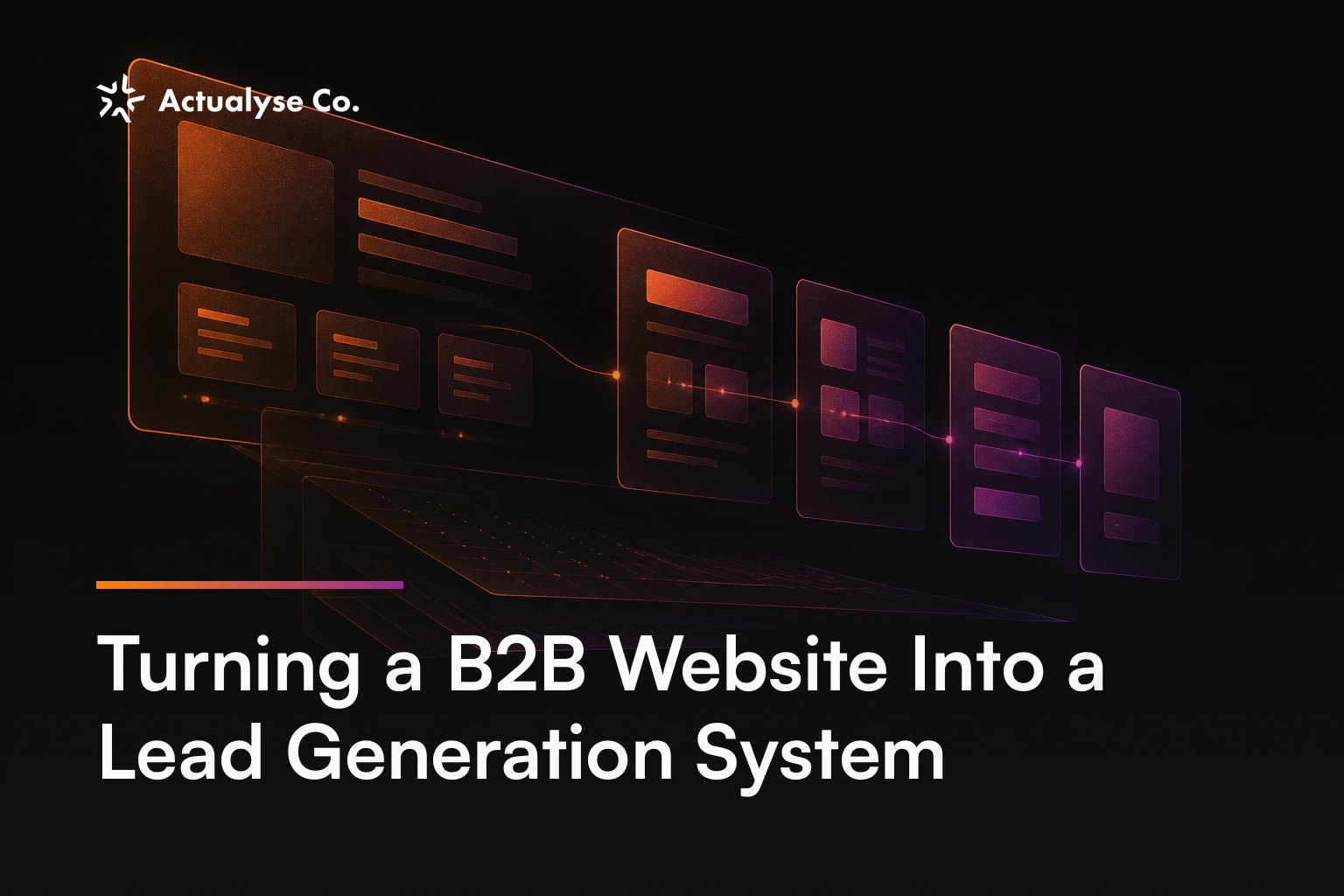
B2B website lead generation fails at the ready-now bias
More traffic will not rescue a B2B website built only for buyers ready to speak to sales.
Most B2B sites optimise for that small ready-now fraction and offer nothing useful to everyone else, so traffic rises while enquiries stay flat. A B2B website redesign can make matters worse if it merely adds downloads and calls to action: without a deliberate offer ladder, they create choices rather than progress.
B2B website lead generation is an architectural problem. A site with one conversion route is being asked to serve at least five levels of buyer commitment.
The architecture has four jobs:
- Recognise the visitor’s decision state. Someone diagnosing a problem needs a different route from someone comparing suppliers.
- Match that state to a useful offer. The next step must complete part of the visitor’s job, not merely expose them to sales.
- Make adjacent progress visible. Each completed step should reveal a sensible higher-commitment action.
- Keep the commercial route available. Ready buyers should never be forced through educational material first.
Our project work shows why routing precedes page decoration. Lanteria’s broad Microsoft 365 HR capability set had to serve multiple stakeholder audiences. Savgen’s technical offer crossed industries and product contexts. AfriCap Hub required a route from catalogue filtering into event registration, while Lake Erie Shores separated stay and ownership journeys under one site.
Those projects publish no performance figures, so they demonstrate architectural decisions rather than conversion lift.
A structured B2B website conversion audit can identify where routes disappear. Broader decisions about positioning, hierarchy and rebuilding belong in the guide to a conversion-led B2B website redesign.
Use one immediate trigger: if a page receives at least 15% of qualified landings and offers only a sales conversation, add a lower-commitment route before increasing acquisition spend.
Architecture determines whether traffic becomes momentum or merely a larger bounce report.
Build the five-rung offer ladder
Commitment should rise only after the visitor has received value.
A practical offer ladder has five rungs. These names are examples, but every asset has a specific job and explicit commitment:
- Instant Fit Calculator. It asks for two anonymous minutes and returns an immediate answer about suitability, cost or capacity.
- Demand Leakage Scorecard. It asks for eight minutes and identification in exchange for a saved, personalised diagnosis.
- Buying Committee Decision Pack. It asks for 15 minutes, role selection and internal sharing to help colleagues compare options consistently.
- Lead Architecture Review. It asks for relevant business context and 30 minutes with a specialist who can interpret the problem.
- Commercial Scope Session. It asks for 45 minutes, the appropriate stakeholders, a budget range and a credible decision window.
The ladder is not five equally loud buttons on every page. A page should expose no more than two adjacent rungs: the action matching current intent and the next higher commitment.
A buyer moving from a two-minute calculator directly to a 45-minute commercial meeting is being asked to skip the trust-building middle. Buyers who are ready can still use the persistent commercial route.
The detailed construction of an individual page belongs in our guide to optimising B2B service pages. The architectural decision here is which rung that page should feed and what comes afterwards.
If three or more calls to action receive equal visual weight within the first screenful, reduce them to one primary route and one secondary route.
Offer ladders turn buyer readiness into observable progression.
The free tool is the missing B2B lead-generation rung
Content describes a task; utility completes it.
A small utility that completes the visitor’s task in one session earns repeat visits and branded search that another article cannot. The mechanic is task completion, not content volume.
An industrial supplier could offer a compatibility pre-check. A consultancy could calculate the cost of delay. An HR software company could assess whether a requirement fits its Microsoft 365 environment. None needs to reproduce the paid service; each must remove one piece of uncertainty now.
A useful first release passes four tests: the result appears in one session, visitors already know the required inputs, the output changes an immediate decision, and the tool remains useful without a sales explanation.
Use a concrete build trigger. If at least five of the last 20 qualified prospect questions require the same calculation, comparison or lookup, prototype the utility. If the first useful result needs more than five inputs or more than three minutes, narrow the task.
Ten more articles create ten additional reading options; one dependable utility creates a reason to return.
Task completion creates return behaviour that publishing frequency cannot buy.
Model B2B website lead generation through every rung
A ladder is useful only when its progression assumptions survive arithmetic.
Take an illustrative UK cyber-security consultancy. These are planning assumptions, not Actualyse client results. The model uses 11 labelled inputs:
| Labelled input | Illustrative value |
|---|---|
| Monthly relevant website visits | 6,000 |
| Monthly acquisition spend | £12,000 |
| Visit to Rung 1 completion | 15% |
| Rung 1 to Rung 2 progression | 20% |
| Rung 2 to Rung 3 progression | 25% |
| Rung 3 to Rung 4 progression | 40% |
| Rung 4 to Rung 5 progression | 50% |
| Rung 5 to sales acceptance | 2 in 3 |
| Average sales-accepted opportunity value | £35,000 |
| Direct-contact-only enquiry rate | 0.10% |
| Direct-contact-only sales acceptance | 50% |
The ladder arithmetic is:
6,000 visits × 15% = 900 Instant Fit Calculator completions
900 completions × 20% = 180 Demand Leakage Scorecards
180 scorecards × 25% = 45 Buying Committee Decision Pack users
45 pack users × 40% = 18 Lead Architecture Review requests
18 review requests × 50% = 9 Commercial Scope Sessions
9 scope sessions × 2 ÷ 3 = 6 sales-accepted enquiries
6 accepted enquiries × £35,000 = £210,000 sales-accepted pipeline
£12,000 acquisition spend ÷ 6 = £2,000 spend per accepted enquiry
The illustrative direct-contact-only model produces:
6,000 visits × 0.10% = 6 raw enquiries
6 raw enquiries × 50% = 3 sales-accepted enquiries
3 accepted enquiries × £35,000 = £105,000 sales-accepted pipeline
£12,000 acquisition spend ÷ 3 = £4,000 spend per accepted enquiry
That is a modelled comparison of 6 versus 3 accepted enquiries, £210,000 versus £105,000 in pipeline, and £2,000 versus £4,000 in acquisition spend per accepted enquiry. It is not a prediction that an offer ladder automatically doubles performance.
Our falsifiable claim is that Rung 2, the diagnostic, will source the most sales-accepted pipeline over 180 days; higher first-touch opportunity value from any other rung would prove it wrong.
The honest limit here is that first-touch attribution is confounded by return visits, offline referrals and sales reclassification. The model exposes assumptions; it cannot establish causality.
If sales acceptance remains below 50% after 20 enquiries from one rung, narrow that offer’s promise or audience before sending more traffic.
A funnel model exposes assumptions before acquisition spend pays for them.
If this analysis exposes wider gaps in your site, we can turn the evidence into a focused redesign brief — book a call
What does not generate leads
A capture event is not necessarily demand.
Three popular fixes fail because none gives an unready visitor a more useful next commitment.
Gated whitepapers nobody reads
A generic whitepaper charges identity before demonstrating value. The download records curiosity, procurement research or competitive checking as though each were buying intent.
Keep a document gated only when the saved output is personalised or materially useful later. Otherwise, remove the gate and judge the asset by progression into a stronger rung.
Chat widgets on low-traffic sites
A widget creates another communication channel; it does not create the underlying demand. Sparse conversations also make continuous staffing difficult, and a delayed chat reply is merely a slower contact form.
Below 1,000 relevant monthly sessions, default to an asynchronous diagnostic unless the widget already produces at least five qualified conversations each month.
Adding a second contact form
One contact form versus two contact forms changes placement, not commitment. Visitors avoiding a sales conversation have not asked for another route to the same conversation.
A duplicate form deserves to remain only when it serves a genuinely different commercial audience or buying motion.
Demand grows when the offer changes, not when the furniture moves.
Route the offer ladder across the whole site
Visitors enter through search, Google Ads, referrals, case studies and bookmarked tools, not a planned homepage tour.
Use a three-layer routing map:
- The entry layer groups important pages by the decision visitors are trying to make, regardless of acquisition channel.
- The progression layer assigns the best current rung and one adjacent higher-commitment rung to each entry group.
- The commercial layer keeps a direct route available for ready buyers without making it every visitor’s default.
If more than 60% of qualified landings begin below the homepage, prioritise those entry groups before rebuilding homepage calls to action. Each of the top ten landing pages should expose an appropriate ladder rung within one interaction.
Tone and design still influence trust. The B2B brand personality choices that make a company recognisable can strengthen an offer, but personality cannot replace a missing route.
When the map requires changes to navigation, templates and reusable components, the work has become website design and redesign, not a button-copy exercise. Teams with an agreed route map can then scope the implementation through a defined B2B website build.
Record the originating rung, sales acceptance and opportunity value. Downloads and bookings are intermediate signals; sales-accepted pipeline is the commercial test.
Sitewide routing turns isolated assets into a lead-generation system.
FAQ
How long should a new offer remain live before it is judged?
Use the later of 90 days or 30 qualified completions. If 30 completions produce fewer than six appropriate progressions, revise the promise; if progression occurs without accepted enquiries, revise the audience or qualification logic.
Who should own the offer ladder?
Marketing owns progression, sales owns the acceptance decision within five working days, and the relevant technical team owns utility accuracy. If no owner can approve a rung change within ten working days, appoint one executive owner.
Should Google Ads traffic land directly on a free tool?
Send calculate, compare and check queries to the utility. Send supplier, pricing and demo queries to the commercial route. If one campaign mixes those two intent groups, split it before judging either destination.
When should a free tool be built as bespoke software?
Prototype with no-code tooling when the logic has ten rules or fewer and uses no sensitive account data. Choose a bespoke build when the logic exceeds ten rules, requires system access or affects a regulated decision.
Commercial intent should determine the first build, not production convenience.
Summary
Apply five operating rules:
- Add a lower rung when a page drives 15% of landings but offers only sales contact.
- Show no more than two adjacent offer rungs on any entry page.
- Prototype a utility when five of 20 qualified questions repeat the same task.
- Narrow an offer when sales acceptance stays below 50% after 20 enquiries.
- Compare sales-accepted opportunity value over 180 days, not downloads over 30 days.
A lead-generation system gives every qualified visitor a sensible next commitment.
Actualyse designs and rebuilds B2B websites that turn research visits into qualified pipeline. Book a call to talk through where yours stands.